


Last updated: August 27, 2026. Please check back as we continue to add content to this teaching module.
Introduction
This module consists of 6 sections (see outline below) with activities based on the following phenomenon and guiding question.
Phenomenon
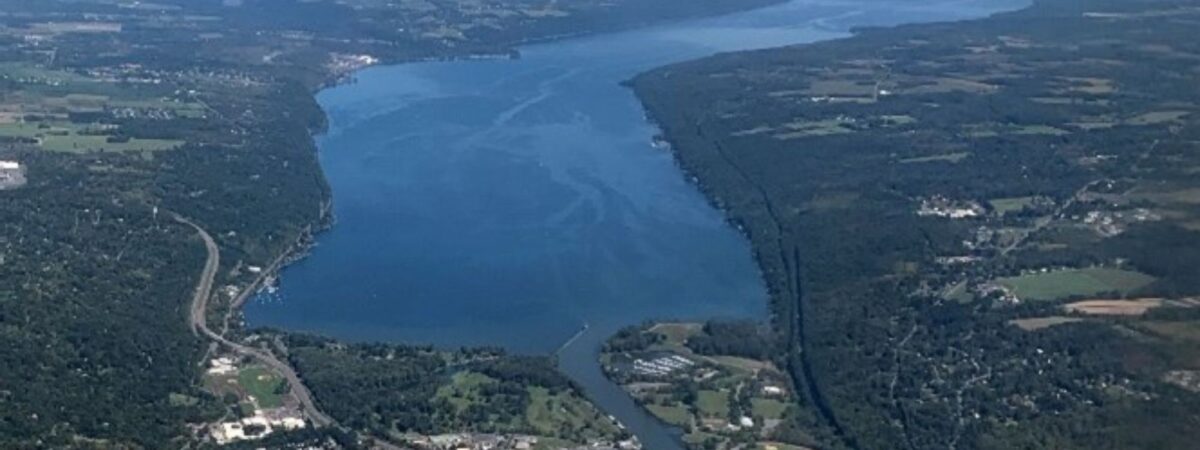
As I was walking along the beach of Cayuga Lake one day, I came across a family looking at a sign posted by the swimming area of the lake park. The Father said “My family was planning a fun day at the beach with lots of water-related activities. Then we encountered this new sign:”
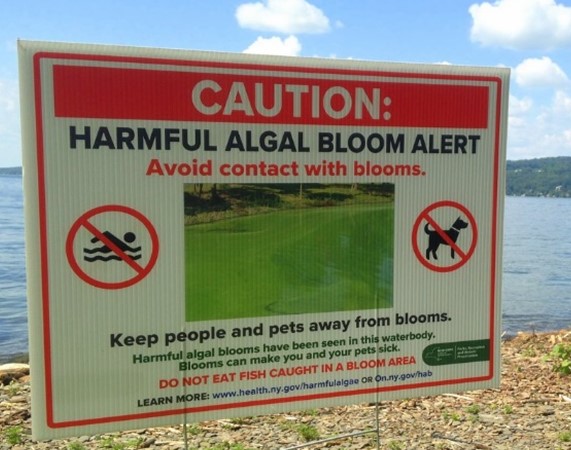
Sign Text:
CAUTION: HARMFUL ALGAL BLOOM ALERT—Avoid contact with blooms. Keep people and pets away from blooms. Harmful algal blooms have been seen in this waterbody. Blooms can make you and your pets sick. DO NOT EAT FISH CAUGHT IN A BLOOM AREA.
Guiding Question
Why are harmful algal blooms (HABs) happening and what can my family do so we can all get in the water again (including our pets)?
Grade level: 6-8, 9-12
Credit and Contact Information: Mark Johnson, mjohnson71264@gmail.com
Time Required: Most sections require 3 to 4 class periods.
Matching to New York State P-12 Science Learning Standards: see details in Outline below.
Module Outline
Section 1: Energy in our lake [Download Word file, Version 1.0, Oct. 23, 2025, 1.5 MB]
- Building a food web - Energy flow
- Standards:
-
5-LS2-1. Develop a model to describe the movement of matter among plants (producers), animals (consumers), decomposers, and the environment.
-
HS-LS2-3. Construct and revise an explanation based on evidence for the cycling of matter and flow of energy in ecosystems.
-
- Standards:
- Follow the carbon
- Standards:
-
MS-PS1-5. Develop and use a model to describe how the total number of atoms does not change in a chemical reaction and thus mass is conserved.
-
HS-LS1-5. Use a model to illustrate how photosynthesis transforms light energy into stored chemical energy.
-
- Standards:
- Cellular respiration versus photosynthesis
- Standards:
-
MS-LS1-6. Construct a scientific explanation based on evidence for the role of photosynthesis in the cycling of matter and flow of energy into and out of organisms.
-
MS-LS1-7. Develop a model to describe how food molecules are rearranged through chemical reactions to release energy during cellular respiration and/or form new molecules that support growth as this matter moves through an organism.
-
- Standards:
Section 2: Plankton in the lake [Download Word file, Version 1.0, Oct. 23, 2025, 730 kB]
- Collection: Plankton - what is a plankton tow?
- Collection Equipment
- Standards:
-
MS-ESS3-3. Apply scientific principles to design a method for monitoring and minimizing a human impact on the environment.
-
- Standards:
- Phytoplankton vs. zooplankton
- Standards:
-
HS-LS2-3. Construct and revise an explanation based on evidence for the cycling of matter and flow of energy in ecosystems.
-
- Standards:
Section 3: Nutrient loading - the algal bloom cascade [Download Word file, Version 1.1, July 17, 2026, 2 MB]
- Nutrient sources mapping activity
- Standards:
-
5-PS3-1. Use models to describe that energy in animals’ food (used for body repair, growth, motion, and to maintain body warmth) was once energy from the Sun.
-
MS-ESS3-4. Construct an argument supported by evidence for how increases in human population and per-capita consumption of natural resources impact Earth’s systems.
-
- Standards:
- Design project: building a watershed
- What makes the bloom happen?
Section 4: Harmful algal blooms on Cayuga Lake [Download Word file, Version 1.0, July 17, 2026, 2.5 MB]
- History of harmful algal blooms –mapping activity
- A history of climate change in New York
- Standards:
- ESS2-4. Use a model to describe how variations in the flow of energy into and out of Earth’s systems result in changes in climate.
- Standards:
- Climate change and HABs
- Standards:
-
MS-LS2-4. Construct an argument supported by empirical evidence that changes to physical or biological components of an ecosystem affect populations.
-
HS-ESS2-4. Use a model to describe how variations in the flow of energy into and out of Earth’s systems result in changes in climate.
-
- Standards:
Section 5: Harmful algal blooms and climate change [Download Word file, Version 1.0, August 27, 2026, 5.1 MB]
- Research activity: The biology of HABs
- The impact of runoff: Water quality and what is going into our lake?
- Why is it dangerous for you and your pets to go swimming in our lake if there’s a harmful algal bloom?
-
- Standards:
-
HS-LS2-2. Use mathematical representations to support and revise explanations based on evidence about factors affecting biodiversity and populations in ecosystems of different scales
-
- Standards:
Section 6: Student theories [Download Word file, Version 1.0, August 27, 2026, 544 KB]
- Data analysis: What did you learn from sections one through 5?
- Where does climate change fit in?
- What can we do individually and globally?
- Putting it all together: how do we talk about these ideas?
-
- Standards:
-
MS-LS2-5. Evaluate competing design solutions for maintaining biodiversity and protecting ecosystem stability.
-
MS-ESS3-3. Apply scientific principles to design a method for monitoring and minimizing a human impact on the environment.
-
HS-LS2-7. Design, evaluate, and refine a solution for reducing the impacts of human activities on the environment and biodiversity.
-
HS-ESS3-4. Evaluate or refine a technological solution that reduces impacts of human activities on natural systems.
-
HS-ETS1-2. Design a solution to a complex real-world problem by breaking it down into smaller, more manageable problems that can be solved through engineering.
-
- Standards: