



Overview
Climate is affected by processes larger than just weather. The atmosphere forms a protective ‘blanket’ around Earth, helping to trap some of the heat energy from the Sun. The atmosphere has the ability to be a blanket for us because of the greenhouse gases that have existed in the atmosphere for millions of years, but humans are adding more carbon dioxide to the atmosphere very quickly. This is changing the composition of the atmosphere that humans have become accustomed to, and increases the thickness of the ‘blanket,’ which traps more heat energy, which can affect climate in many ways.
Introduction
This activity looks at how humans contribute carbon dioxide to our atmosphere.
Grade Level
K-5, 6-8
Learning Objectives
Students will be able to analyze how human additions of carbon dioxide can influence the chemistry of the atmosphere.
Lesson Format
This activity can be done indoors!
Time Required
1 Hour
Credits & Contact Info
Trisha Smrecak and Caroline Boyajian
Paleontological Research Institution, 1259 Trumansburg Rd., Ithaca NY 14850
climate@priweb.org
Instructions & Materials
Materials
- Large clear container, like a bucket or punch bowl
- Blue food coloring
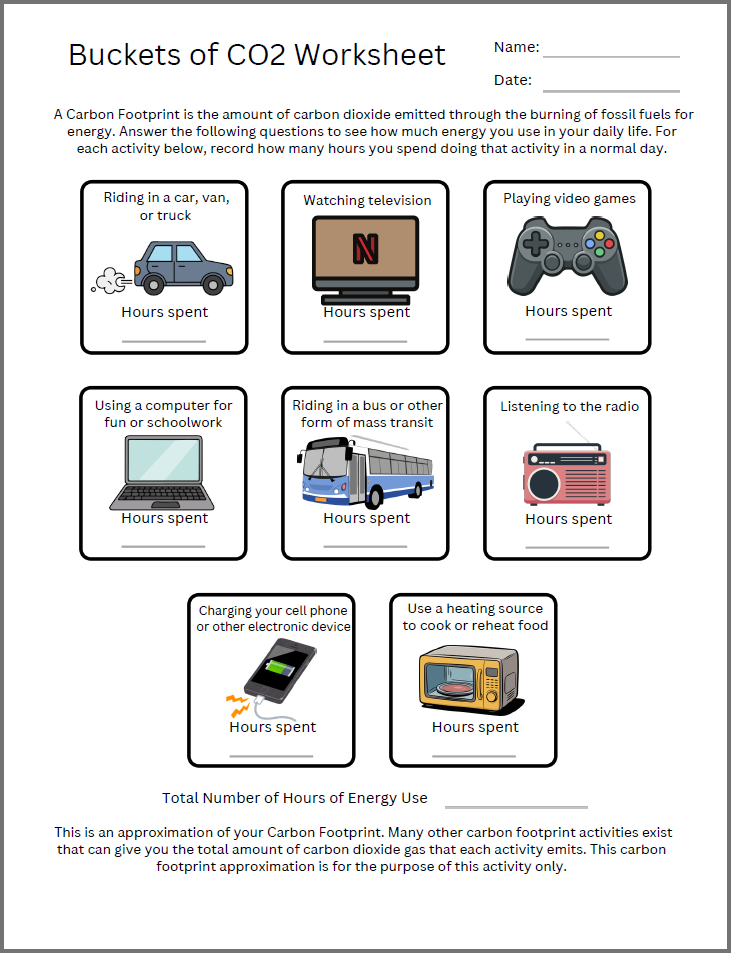
- Carbon footprint worksheet
Instructions
- Explain to youth that carbon dioxide is a greenhouse gas, along with other things like water vapor, methane, and other gases. When humans burn fossil fuels for energy use, like transportation, heating and cooling buildings, and watching TV, carbon dioxide is released into the atmosphere.
- Explain that youth will calculate their carbon footprint, which is the amount of carbon dioxide they emit into the atmosphere by filling out the worksheet. Then they will learn how activities in their community can affect climate locally and globally.
- After youth fill out their worksheet, have them talk about what they learned about themselves. In what part of their lives do they use the most energy, and why?
- Fill a large bucket with water. Explain that this bucket of water represents Earth’s atmosphere.
- Hand out vials of food coloring to youth. Explain that the food coloring will represent the addition of carbon dioxide that humans add to our atmosphere. Naturally, Earth regulates the atmosphere pretty well, keeping it in balance, but human activity can rapidly change the atmosphere.
- One by one, have youth put food coloring into the bucket. The number of food coloring drops each adds to the bucket should equal the number on the bottom of their worksheet. If it is a large group, pick out an average number from the group and use that number for the example to prompt discussion.
- Discuss what they see. Would it be easy to remove all of the carbon dioxide (food coloring) they just added to the atmosphere? In comparison to the amount of water that is in the bucket, did your group add a lot of food coloring, or is there more water in the bucket than food coloring?
Discussion
There are a lot of naturally occurring greenhouse gases in our atmosphere. We should actually be happy that they are there. It helps Earth stay warm enough to keep animals and plants alive. Mars has almost no greenhouse gases and it is too cold for life to exist on that planet. Venus has a ‘runaway’ greenhouse effect, where it has way too many greenhouse gas particles in the atmosphere, and it is too hot for life to live on the planet. As Venus and Mars show, the composition of an atmosphere can certainly affect the planet’s climate.
That said, humans only contribute a small amount of greenhouse gases to the atmosphere in addition to what is already there. But in the activity, we learned that even a small amount of food coloring, our ‘carbon dioxide,’ can impact the atmosphere a lot. Once done, it's done. In fact, the carbon dioxide we emit today can stay in the atmosphere for up to 1,000 years. That is why it is important for us to try to use less energy in our daily lives. Carpool with a friend, or combine multiple trips to the store to burn a little less gasoline. Turn lights, T.V.s, and computers off when not in use. What are some other things you can think of doing to lower the amount of carbon dioxide you put into the atmosphere each day?
Extensions
To convert energy use into carbon dioxide emissions for everyday actions, you can use this website from the U.S. Environmental Protection Agency: Greenhouse Gas Equivalencies Calculator.
CoCoRaHS Extension Ideas:
Have youth become familiar with numerous carbon footprint calculators by searching for them online. Test each calculator to see how it measures an individual or group carbon footprint. Decide which calculator uses the best measurements to approximate carbon dioxide emission accurately for your group. Apply this to individuals, the group, and even the entire community and present those results to neighbors and municipal officials.