


Overview
Our weather and climate are part of a closed system. The Earth is enveloped by the atmosphere, which protects it from the harshness of the rest of the Solar System. As such, wind is created from things that already occur in our atmosphere, like the heating up of air masses by the Sun and the rotation of the Earth. When the Sun shines down on Earth, it heats the air unevenly. Air tends to get warmer along the equator and cooler near the poles because of the angle at which the Sun’s rays hit the Earth.
Introduction
In this activity, we look at the different pieces of the climate puzzle that, when put together, create our winds.
Grade Level
K-5, 6-8
Learning Objectives
Students will be able to describe the physical properties that contribute to the formation of the wind.
Lesson Format
This activity can be done indoors!
Time Required
1 Hour
Credits & Contact Info
Trisha Smrecak and Caroline Boyajian
Paleontological Research Institution, 1259 Trumansburg Rd., Ithaca NY 14850
climate@priweb.org
Instructions & Materials
Materials
- Ball (to represent globe)
- Water
- Flashlight
- Lazy susan
- Piece of cardboard 15 inches square
- Scissors
- Ruler
- Marker
- Large, lightweight trash bag
- Powerful hair dryer
- Cool room with a high ceiling
Instructions
Part 1.
- Ask the youth if the ball were a globe, where would the North Pole, South Pole, and equator be. Label these on the ball with a washable marker.
- Turn the ball so that the equator is running parallel to your body and your fingers are on the North and South poles.
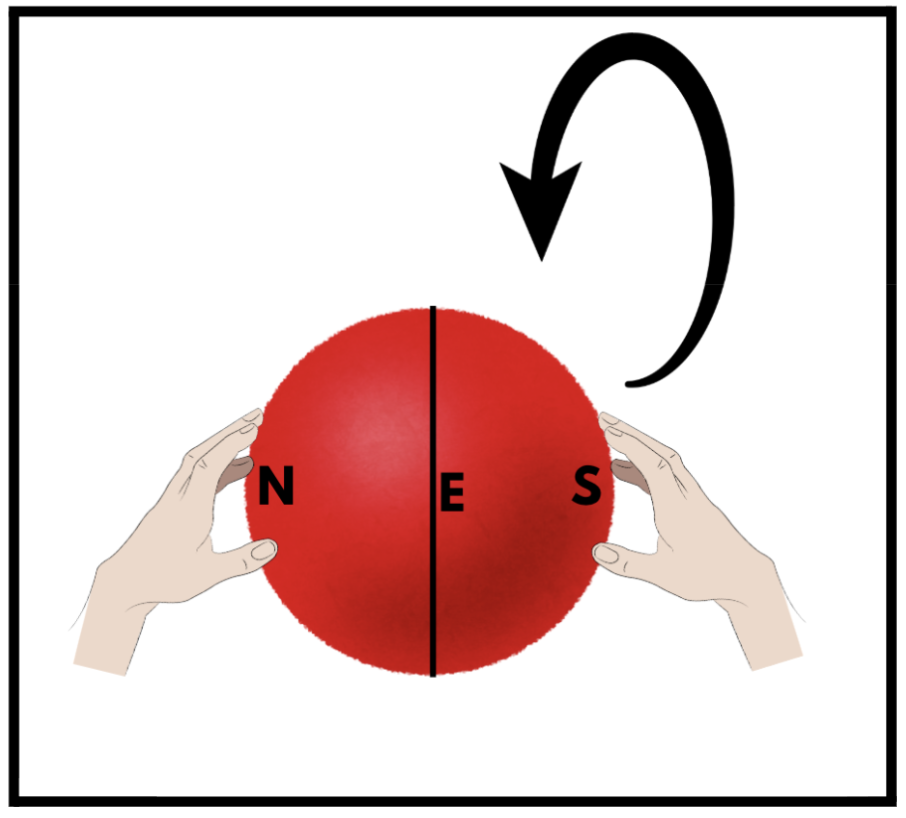
- Ask the youth where water would fall if it were poured on top of the ball. Have them pour some water on the ball to check their answer. A cupful should be sufficient.
- Ask what would be different if the ball were rotating when the water was poured. Have them pour more water on the ball while it is turning to check. Note: for the correct rotational motion, the ball should be spinning counter-clockwise on its axis when you’re looking at the North pole from above.
- Explain that the ball represented the globe and the water represented the air surrounding the globe. When the globe is turning, it deflects air away from the equator and toward the poles, so when you poured water on the ball, it was deflected from wherever it was poured toward the poles.
- Rotate the ball so that the North and South Poles are directly vertical, and the equator is where your hands are grasping the ball.
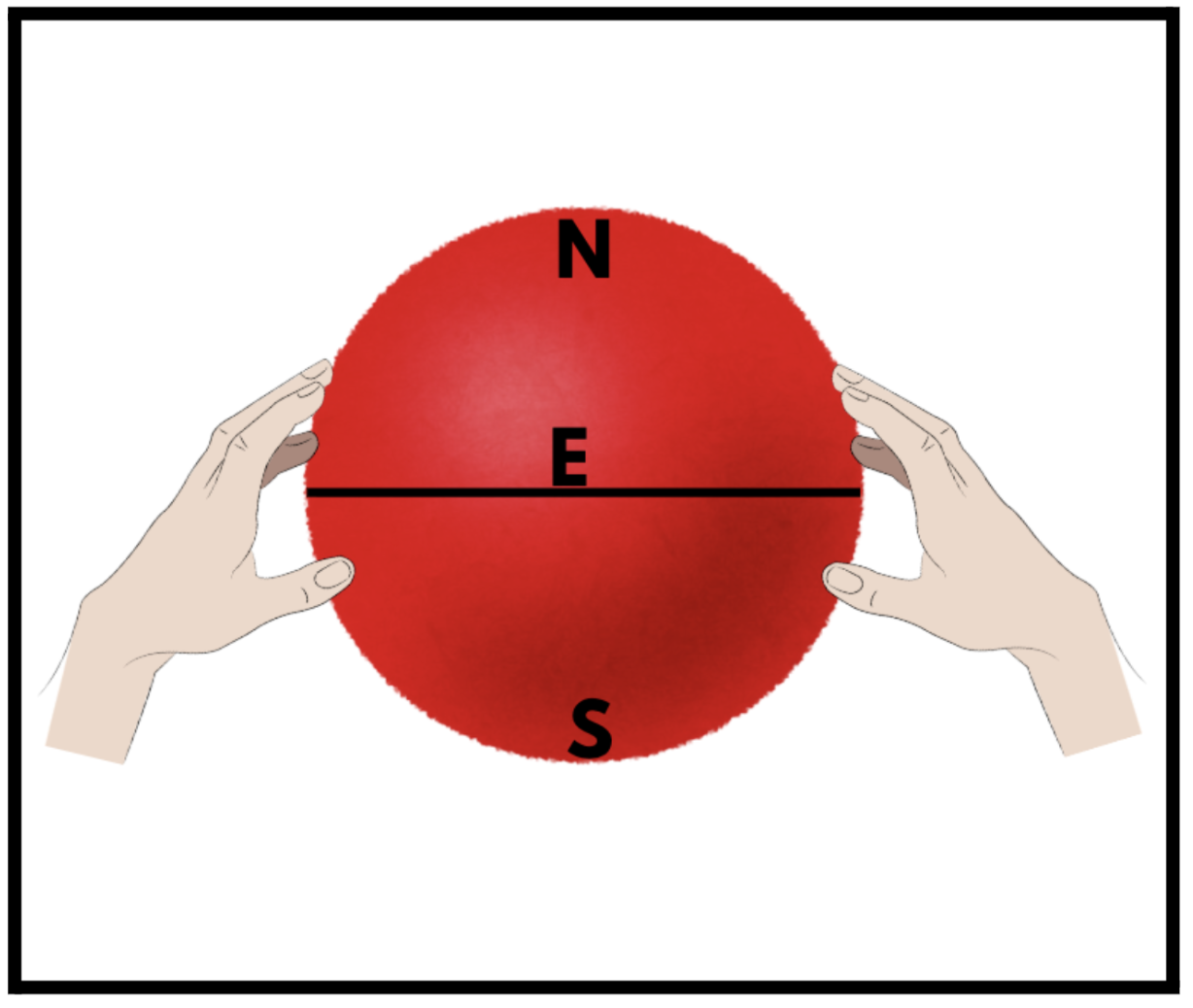
- Have someone shine the flashlight directly onto the ball, aimed at the equator, and in exactly the same plane as the equator.
- Ask where the sun shines most brightly; turn the ball to explain day and night, sunrise and sunset.
- Ask students if the way you are holding the ball is exactly how the Earth sits in orbit (the answer is no; Earth is tilted about 23 degrees).
- Tilt the ball so that the North Pole is about 23 degrees away from vertical, and have the flashlight shine on the ball again from the same angle as the first time. Discuss what is different about the areas on the ball/globe that are now lit up.
Part 2.
- Cut a circle out of the cardboard the size of the lazy susan being used.
- Make a dot in the center to represent the North Pole.
- Place the cardboard ‘record’ on the lazy susan.
- Using a ruler and a marker, draw a straight line from the center of the cardboard to one edge.
- Turn the lazy susan counterclockwise. Using the marker, try to draw another straight line from the center to the edge as it is turning.
- Examine the second line and discuss what is different from the first.
Part 3.
- Fill the trash bag with hot air using the hair dryer, then close and seal the opening.
- Release the bag, watch it rise. Point out that warm air weighs less than cool air.
- Ask the youth what they think will happen next (the air will cool, the trash bag will come back down).
Discussion
These activities illustrate some of the forces acting on wind: the Coriolis effect and the Sun’s rays.
Warm air weighs less, so it floats on top of cool air. When the trash bag moved, it was just acting as a place holder for the air, so we could see the air actually move. The warmer the air is relative to the surrounding cool air, the faster and higher it will travel.
When the Sun heats the air, it warms and moves upward, and cool air moves down to take its place. We discussed in the introduction that the equator gets more energy from the Sun, so air flows up near the equator. It gets deflected by the rotating Earth, and as it moves upward and away from the equator, it gets cooler. This deflection is the same as the one seen when we poured water on the rotating ball. This creates a big circular path called a convection cell, or Hadley cell, when talking about weather.
Discussion Questions:
What did you notice about the two activities showing the deflection caused by rotating the Earth?
Since the Sun shines more directly on the equator than it does on the poles, why doesn’t the equatorial region keep getting hotter and hotter until it would be so hot that nothing could live there? (Answer: there are two things on the planet that move and transport heat away from the equator and toward the poles - the air in the atmosphere and the water in the oceans.)
Extensions
Link to earth.nullschool.net, a global wind map: https://earth.nullschool.net/
CoCoRaHS Extension Ideas:
Print off a copy of the United States map with the associated precipitation measurements for the day from the CoCoRaHS website. Using another source, like the internet or a television weather forecaster, plot the path of the Jet Stream on the map of the United States. What direction does the Jet Stream flow? What physical systems are causing the Jet Stream to flow, and what impact does the Jet Stream have on the weather and climate of the United States?