

Overview
The hydrologic cycle, or water cycle, is the basis for most of our weather events and climate regimes. It is very important to understand that there is only so much water available to us on Earth, and that only a small percentage is freshwater. Also, the same water on the planet today has been cycling for millions of years, so it is possible that the water we drink today may have been the same water that was here 70 million years ago! Since water is a limited resource, the same water here today was here when dinosaurs roamed the Earth.
Introduction
This activity will explore how water cycles through the planet, and give insight into how long water remains in each part of the cycle.
Grade Level
K-5, 6-8
Learning Objectives
Students will be able to identify the water cycle and its components, as well as water residence times in various stages.
Lesson Format
This activity can be done indoors!
Time Required
1 hour
Credits & Contact Info
Note: This activity was adapted from one developed by Project WET.
Trisha Smrecak and Caroline Boyajian
Paleontological Research Institution, 1259 Trumansburg Rd., Ithaca NY 14850
climate@priweb.org
Instructions & Materials
Materials
- 9 large pieces of paper
- 30-50 beads in each of 9 different colors
- a pipe cleaner for each youth
- Old gift boxes or shoe boxes for making 9 home-made dice
Preparation Needed:
- On each sheet of paper, draw and label (or have the youth draw) one of the nine scenes listed: clouds, animals, lakes, soil, groundwater, rivers, oceans, plants, glaciers.
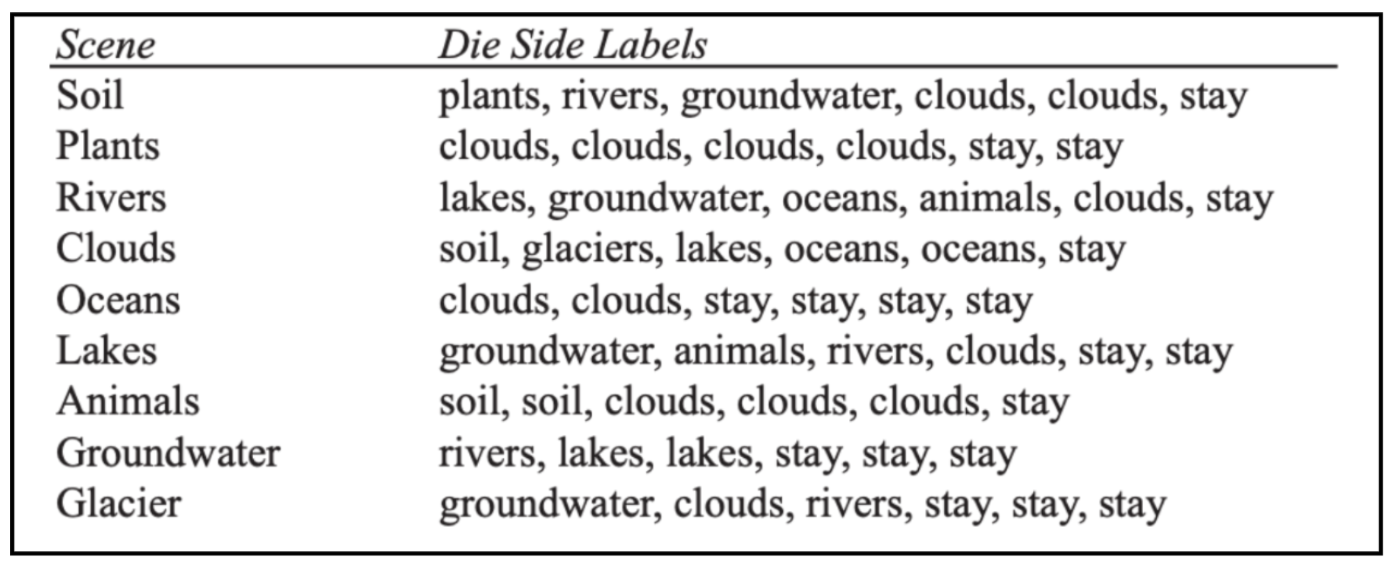
- Out of old gift boxes, shoe boxes, etc., create nine 6-sided dice that can be read from 4 ft away. Each die will be associated with a specific scene (above), and has different labels (see table below for the labels).
Instructions
- Place the 9 sheets of paper with scenes, their respective die, and their coordinating beads (one color per scene) around the room. If outside, you may wish to place things relative to their geographic positions (i.e. plants, animals, rivers, lakes, and soil closer together, ocean, groundwater, glaciers at a distance, etc.).
- Hand out pipe cleaners and explain that everyone will travel the room as water molecules going through the water cycle. Their pipe cleaner is a map, or timeline, of where they have been. As they travel from place to place, they should collect a bead to represent the time they spend in each place.
- Fold a hook into the end of the pipe cleaner to prevent beads from falling off the timelines
- Tell the youth to pick a place to start their journey as a water molecule. Try to evenly space them to begin.
- Ask the youth about water at each station. How would it travel between the different scenes? Tell the youth that as they travel, they need to think about how their water molecule would travel from one place to another (melt, evaporate, etc.).
- Explain that in this game, a roll of the die determines where you will go. At each station, line up in a single file, collect a bead, and place it on your pipe cleaner, then roll the die. If the die tells you to go to a different station, go to that station and repeat. Be sure to collect beads every time a die is rolled, even if you repeatedly roll a ‘stay.’
- Each bead represents 10 years in the cycle of their water molecule. Have them total up how much time they spent in each station. Use the discussion session of this activity to supplement steps 6-9.
- Choose 1 or 2 timelines to discuss. Write how much time they spent at each station on the board or on a sheet of paper. Discuss where water spends most of its time (oceans, clouds, glaciers, underground) and why (huge storage capacity, less likely to cycle).
- Draw the hydrologic cycle on the board or on a sheet of paper with all of the stations represented in one picture. Using a red pen for water travel in gas form and a blue pen for water in liquid/solid form, draw the path of one youth's water molecule journey. Be sure to put arrows in the direction of travel. Each youth may decide to draw their own path.
Discussion
Ask what they noticed about their molecule travels (they got caught in the glaciers, in groundwater, or in the ocean). There were always long lines at those stations. Help them connect their experience to the fact that most of our water is stored in glaciers, groundwater, and oceans
Ask the youth to hold up their pipelines and describe them. Did many people travel to all of the sample places? Do some pipe cleaners have almost all of one or two colors? Who spent the most time at one place (had the largest number of the same beads) and who went to the most places (had the most different colored beads)? Relate this to the amount of time water spends in an animal or plant as compared to in an ocean, glacier, or groundwater.
Water can stay trapped in the ground, in the ocean, or in a glacier for decades and centuries. While it all cycles through eventually, some water travels a lot while other water hardly ever moves. The same water you’re drinking today could have been in an ocean filled with dinosaurs and other extinct animals!
Discussion Questions:
- Why is it so important to prevent water pollution?
- How much of the water on Earth is available for us to drink? That is, how much of the water on Earth is not saltwater in the ocean, not frozen in glaciers and the ice sheets that cover Antarctica and Greenland, not so deep underground that we can’t access it, and not polluted? Students could make guesses and then research the answer (see Project WET activity “A Drop in the Bucket”.)
Teaching Tip
This activity could also be done with string instead of pipe cleaners, and each student would end up with a string of beads that could be turned into a bracelet. In the beginning, one would need to tie a large knot at one end or tie a knot around the first bead, to prevent beads from slipping off.
Background
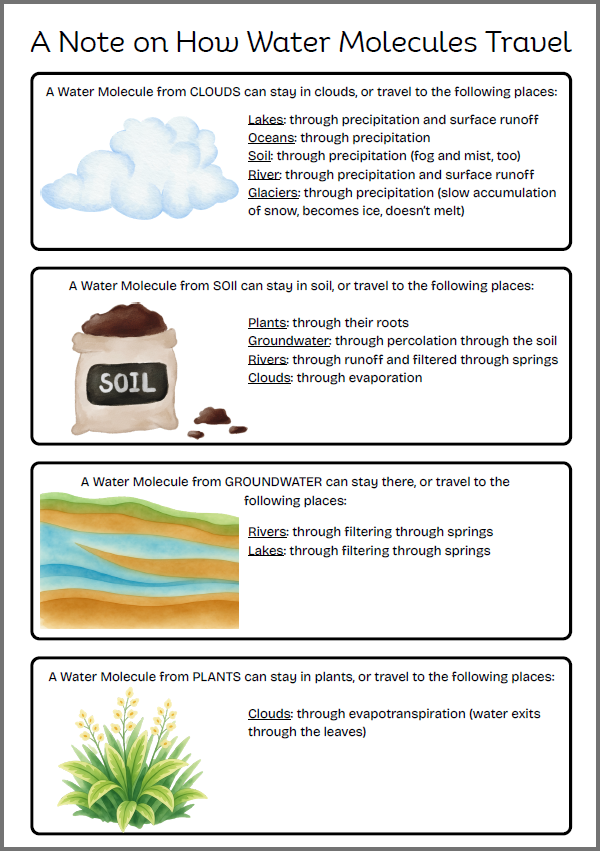
Since the activity requires participants to have some understanding of how a water molecule
can get from one location to another, this worksheet explains how water can be transferred from each
of the scenes in The Incredible Journey.