


Overview
Long before we had weather forecasters presenting weather information, communities recorded weather data for farming and other purposes. Now that we know more about weather, rain, and snow, we can record information ourselves and compare what we know to what our local weather person has predicted.
Introduction
This activity has youth journal their winter weather to learn more about the variation during the season and about making scientific observations.
Grade Level
K-5, 6-8
Learning Objectives
Students will be able to describe winter weather, measure and record pertinent weather information, and compare it to media predictions.
Lesson Format
This activity can be done indoors!
Time Required
Throughout winter
Standards
Credits & Contact Info
Trisha Smrecak and Caroline Boyajian
Paleontological Research Institution, 1259 Trumansburg Rd., Ithaca NY 14850
climate@priweb.org
Instructions & Materials
Instructions
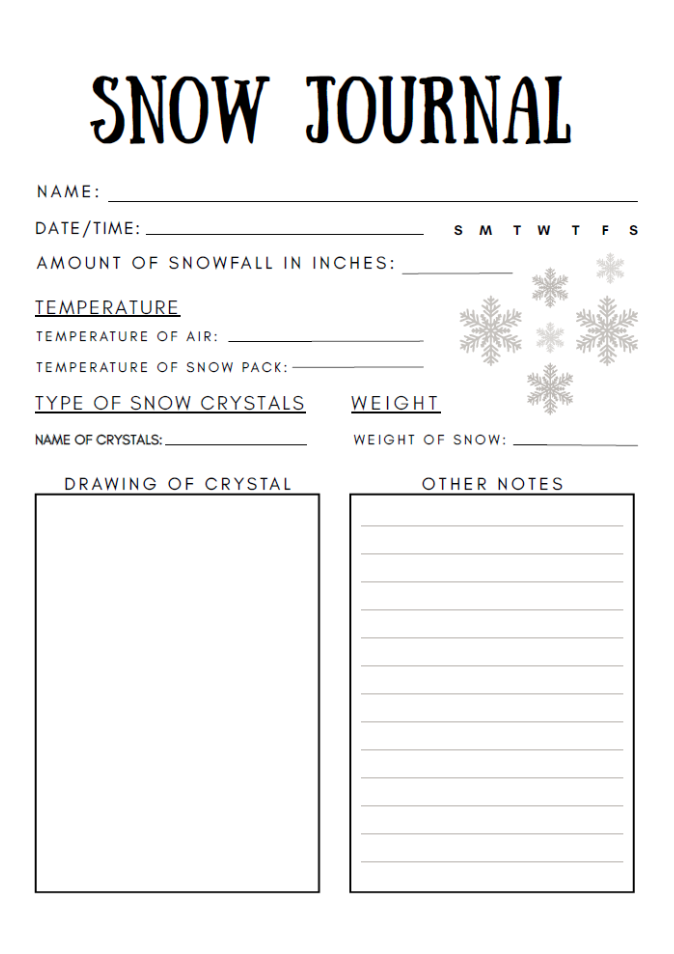
- Youth make a winter weather observation journal, decorating it as they like.
- During snowfalls, youth record the following for each entry:
- Date, time, amount of snowfall
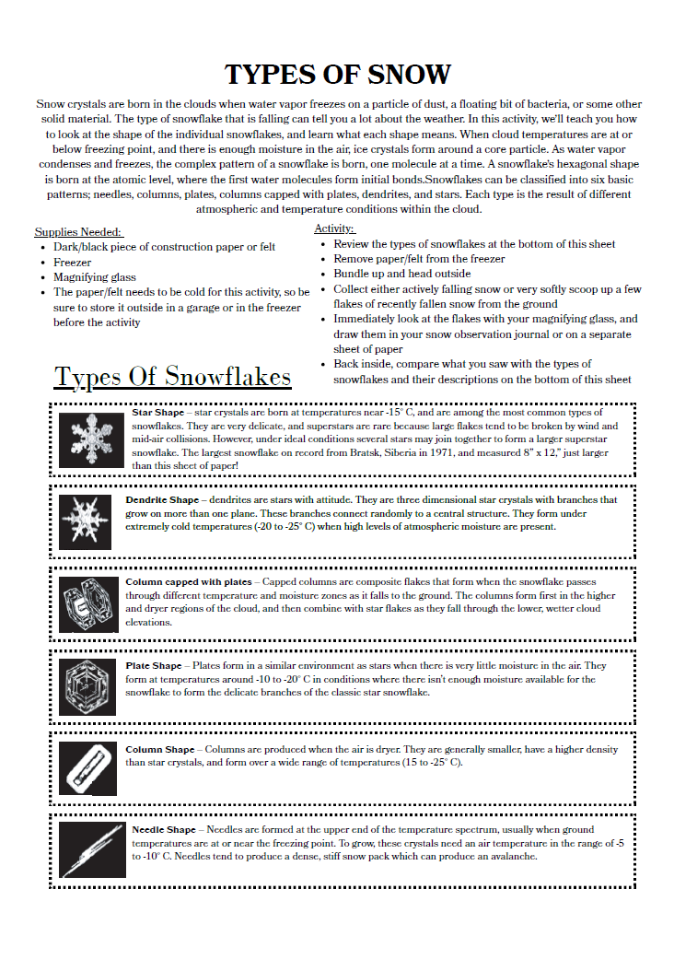
- Temperature of air, temperature of snow pack on ground - kinds of snow crystals observed (see Types of Snow handout)
- How well the snow packs into snowballs
- Weight of snow *scoop snow into measuring cup (do not compact snow), then use ruler to scrape off excess snow so it is even with the lip of the measuring cup *weigh the cup on scale with and without snow in the cup.
Discussion
Discuss observations with the group. Is there a correlation between the type of snow crystals observed and the weight of the snow? How well does the snow pack? Discuss snow weight and density with your group, relating it to the above questions. Encourage weather journals to continue, recording temperature and precipitation in the other seasons. Ask them to determine what important measurements should be taken year-round.
Discussion Questions:
- Is there a correlation between the type of snow crystals observed and the weight of the snow?
- How well does the snow pack?
- What important measurements should be taken year-round?
Teaching Tip
Students will likely need instruction on how to measure snowfall. CoCoRaHS has training materials. See, for example, slides 4, 16, and 17 in this pdf of a slideshow on making snow measurements.
Extensions
CoCoRaHS Extension Ideas:
Maintain records of snowfall as a group for a set amount of time, like a week or a month. Keep these records for at least two separate locations (using CoCoRaHS data in your community if available, or measure it yourself). Compare and contrast the amount of snow in each location. Also, compare whether snow always falls in both locations or if one location observes snowfall more frequently than another. Take a picture or observe the areas where data were collected, if possible. What geographic similarities do they have that would affect snowfall? What differences?