


Overview
Rain comes from clouds in the sky; that’s an easy observation to make. But where do the clouds come from? And where does the water that puddles on our driveways disappear to after a rain?
Introduction
In this activity, we’ll see where rain comes from and where it goes by using a cup as a lake (water reservoir) and a bag as our atmosphere.
Grade Level
K-5, 6-8
Learning Objectives
Students will be able to discuss how water travels through the water cycle in a closed system.
Lesson Format
This activity can be done indoors!
Time Required
2-3 hours
Credits & Contact Info
Trisha Smrecak and Caroline Boyajian
Paleontological Research Institution, 1259 Trumansburg Rd., Ithaca NY 14850
climate@priweb.org
Instructions & Materials
Materials
- Small cup/container for water (a 3 oz. cup works well)
- Ziplocking bag larger than the container
- Room temperature water
- Windowsill on a sunny day
Instructions
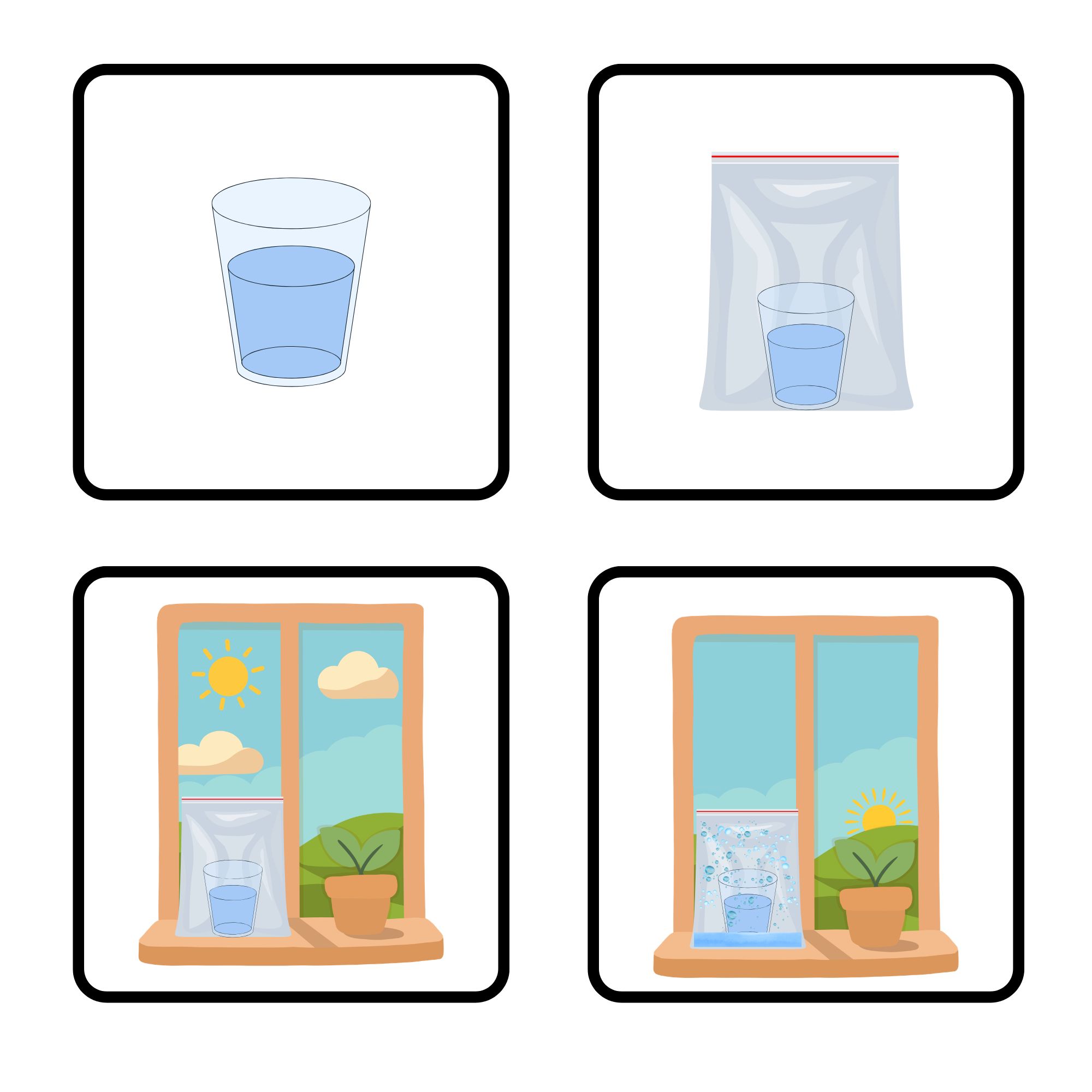
- Pour a small amount of water into the Dixie cup, filling it about halfway.
- Place the cup into a Ziploc bag and close it. Discuss how the bag is symbolic of the atmosphere, encapsulating the Earth and all its sources of water. The cup is a sink for water, like a lake or ocean.
- Place the bag with the water-filled cup on a windowsill on a sunny day. Predict what will happen inside the bag.
- Check often and observe any changes happening in the bag.
- After a few hours, observe the bag again. Water is now lying on the bottom of the bag.
Discussion
Matter is neither created nor destroyed. Therefore, all of the rain/snow/hail we experience is recycled water from some other source. This recycling process is called the water cycle. Water in the cup represents water in a basin, like a lake or an ocean. When it was heated by the Sun, the water evaporated. However, the bag, which represents our atmosphere, created a closed loop. Eventually, the evaporated water condensed on the bag and precipitated toward the bottom of the bag. The puddles of water sitting outside the cup at the end of the experiment represent the streams and rivers that fill with runoff from rain and melting snow, eventually running into a lake or a stream. This activity recreated the water cycle that the Earth benefits from every day!
Discussion Questions:
- How did the water get to where it ended up?
- How is this representative of our water cycle?
Teaching Tip
This activity works best on a sunny day.
Extensions
CoCoRaHS Extension Ideas:
In your CoCoRaHS investigation, you record precipitation from a rain gauge each day in the summer and use your gauge and a snow pad in the winter. During the summer months, some days you will go out to record your precipitation observation to find that there is nothing in your rain gauge, but that your toes are wet from walking in the grass. The grass is wet because of dew. Investigate what causes dew to form on your grass. Then, for one week, record your precipitation data, and if the grass is dry, a little wet, or very wet.